
Checking for a Warrant in Taneytown
The steps below split the ticket from the court case, since that mix-up trips the most people in Taneytown. Each has its own office.
- Read the citation for the issuing agency, the court, and the due date.
- Search the Maryland Judiciary's public case search by citation number, then by the exact name on the ticket.
- Call the District Court clerk at 410-871-3500 and ask whether the case shows a failure-to-appear event or a warrant.
- Call the Taneytown Police Department for a police report or a citation-processing record.
- Call the sheriff's warrant unit at 410-386-2597 if a warrant may be open and you want to ask about turning yourself in.
Note: Entering a citation number into a payment portal does not confirm whether a warrant is open.
Taneytown's Official-Linked Ticket Portal
Taneytown links a vendor ticket portal from its police pages, and the Taneytown ticket portal lets a person look up and pay a citation the department issued. That works well for a payable ticket. It is not a warrant search. The portal shows a department contact block and the route a ticket takes, and nothing more. There is no active-warrant list on it, no most-wanted roster, and no field telling a reader whether a bench warrant sits on the case. Treat it as the first stop for the ticket itself and the wrong stop for a warrant question. Two systems share one citation number, and only the court controls the second. A Taneytown caller who expects warrant status from the portal will leave empty-handed.
Taneytown Police and Municipal Court
Taneytown has no criminal court of its own. The police department writes citations and serves papers, while the District Court turns a citation into a case. The department sits at 120 E. Baltimore Street, Taneytown, MD 21787. For phone contact, the portal's block shows 410-751-1100, while a county public-safety listing shows 410-751-1150, and the two disagree. So rely on the number printed on the current citation when time is short. Verify it later against the department page. Keep one more thing in mind: a city department can hold a warrant for service even though the court, not the police, issued the order. The paperwork may live in Taneytown while the authority stays with the judge.
Ticket Payment Versus Warrant Confirmation
Paying a ticket and clearing a warrant are two different events. Payment closes a payable citation, and the money goes to the court or its payment vendor. A bench warrant is a separate order, and it stays open until the court marks it satisfied or recalls it on the docket. Nothing about a card transaction changes that. The gap bites hardest after a missed date. A person pays the fine, assumes the matter is closed, and the warrant stays active because nobody asked the court to close it. Taneytown ticket holders should put one direct question to the clerk: does this case show a current failure-to-appear or warrant event, and what step ends it? That single question saves weeks of guessing.
Which Taneytown Phone Number a Citation Holder Should Use
Three phone numbers reach three different services. The number printed on a citation reaches the issuing agency or its payment route. The District Court number reaches the clerk who keeps the case file and can read the docket. The sheriff's warrant unit takes calls from people with an open warrant who want to ask about turning themselves in, and only that unit can explain what a surrender involves. Pick the number by the question, not by convenience. A police desk can confirm that a report exists. A clerk can confirm what the court has done. Calling the wrong office is the most common reason a Taneytown warrant question takes an extra week. Match the office to the errand before dialing.
Taneytown Warrant Types
The type of order decides which office answers next.
| Warrant Type | How It Arises | Who Issues It |
|---|---|---|
| Traffic failure to appear | No response to a citation or no appearance at a traffic date | District Court judge or commissioner |
| Bench warrant | A missed court date, a probation issue, or contempt | Judge, or a clerk under a recorded order |
| Arrest warrant | A charge filed after an investigation and probable-cause review | District Court judge or commissioner; Circuit Court judge |
| Ordinance case | An unresolved city code or local citation | Heard by the District Court |
A payable ticket that is handled on time never reaches this stage.
Requesting a Taneytown Police Record
A police report and a court file live in different offices, so a request should go to whichever one created the document. Reports, citation-processing records, and service notes belong with the town custodian. A Carroll County Sheriff's Office record goes to the sheriff on Form CCSO #157 or through a JustFOIA request. Name the document, the citation or case number, the agency, and a date range. Specific requests move faster. No request, though, can force an office to build a new warrant list that does not exist. The county fee page sets the price: the first two search hours are free, later time runs $25 per hour, and copies cost $0.25 per page. Taneytown requesters should expect those same county figures.
Inside a Taneytown Warrant Record
A Taneytown matter leaves two trails. The town holds the ticket record, the court holds the case record, and the court file controls status.
| Case Number | The District Court case number, which is the identifier a clerk needs first. |
|---|---|
| Citation Number | The number from the town citation, still needed for the ticket record. |
| Charge | The ordinance, traffic, or criminal charge filed by the officer. |
| Issuing Court | The District Court of Maryland in Carroll County, or the Circuit Court for Carroll County. |
| Fine or Bond | Set by the court or a commissioner. No public county bond schedule exists. |
| Status | Issued, outstanding, served, returned, satisfied, or recalled. |
A Taneytown Traffic Failure to Appear
A missed traffic date creates two separate consequences. The court can issue a bench warrant under Maryland's failure-to-appear statute. The Motor Vehicle Administration can also act on the license after an unpaid fine or a missed trial date. Fixing one does not fix the other, a point that surprises many Taneytown drivers. Maryland's traffic page offers one route for asking a court in writing for a new trial or hearing date, and that route is not a general warrant-clearance procedure. Before driving to a courthouse, confirm the building and its entry rules. The Circuit Court's security page lists screening rules and prohibited items for its buildings.
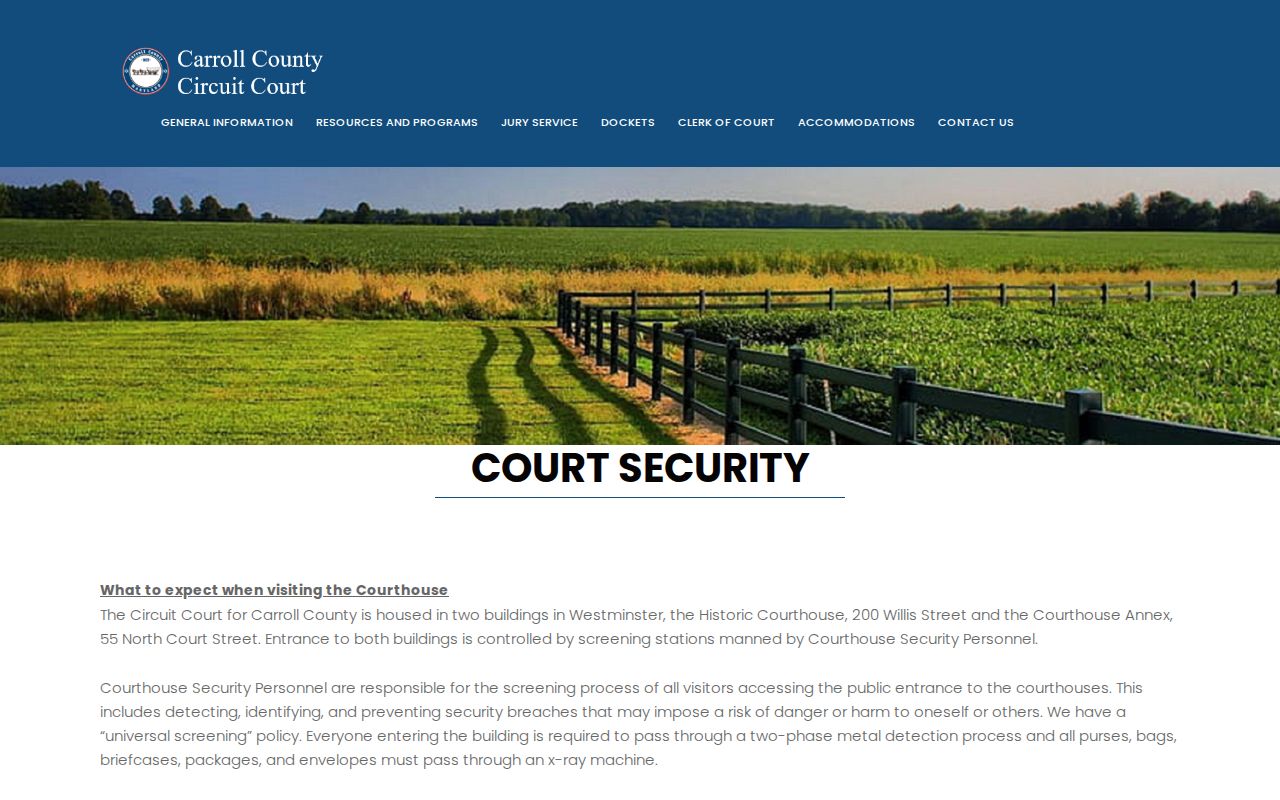
Security screening applies to everyone who enters, so plan for the line.
How Taneytown Warrants Fit the County System
Once a court issues an order on a Taneytown case, the warrant belongs to the county system. The city department may serve it. The sheriff's warrant unit may handle it when the order is assigned countywide or came from another jurisdiction.
Warrant flow: Taneytown Police citation › District Court of Maryland, Carroll County › sheriff's warrant unit service
The Carroll County warrant records page covers the county process. The traffic warrant search page details payment plans, license notices, and hearing options for Taneytown cases.
Taneytown Police, District Court, and the Two Layers of a Case
One arrest leaves two paper trails in Taneytown. The police layer sits at the department: the officer's report, the citation, any record that paperwork was served. The court layer is separate. It holds the charge, the docket, the warrant, the bond, and the next date. Neither office can speak for the other. Taneytown police can confirm service of the papers, while only a clerk can confirm the file shows a warrant satisfied. So ask each Taneytown office only the question it can actually answer. That keeps the process moving in the right order.
Taneytown Warrant Records and Public Access
Want to see the paperwork behind a Taneytown warrant? Court files sit under Maryland Judiciary access rules, open by default unless a statute or court order says otherwise. Law-enforcement records answer to the Maryland Public Information Act instead, and juvenile matters, sealed or shielded files, expunged cases, and active investigations stay closed to ordinary public access.
Key Rules:
General Provisions §4-202: a written request goes to the office holding the record, and a misplaced request is rerouted within ten working days.
General Provisions §4-301: access must be denied where another law, a court rule, or a court order makes the record confidential.
A records request only works for a document that already exists. No Taneytown office can be forced, through such a request, to say whether a warrant is open.